Athens and Area Heritage Museum
The Athens and Area Heritage Museum in Athens, Ontario, is a beloved local institution dedicated to preserving and sharing the rich history of the Athens Township community. Housed in the historic Lions Hall, the museum showcases a wide range of permanent and rotating exhibits featuring local figures, historical artefacts, photographs, and archival materials that tell the story of the area’s past. It has also been a strong community partner with Athens District High School's history program, welcoming students to research, document, and even digitize portions of the museum’s collection as part of this website project, helping younger generations connect with local history in meaningful ways. The museum maintains an active archive and provides resources for local history research, supports heritage programming, and encourages public engagement with the past.
For more information, check out the Athens and Area Heritage Museum Facebook Page or visit them at 12 Wellington Street East, Athens, Ontario.

Photograph from leedsheritage.ca

Athens Cenotaph Drawing
The Athens Cenotaph is dedicated to the men who fought in the First and Second World Wars and the Korean War. It was created by the Women’s Institute of Athens. There is a plaque on the Cenotaph that reads “To The Memory Of Our Boys Who Paid The Supreme Sacrifice In The Great War”.

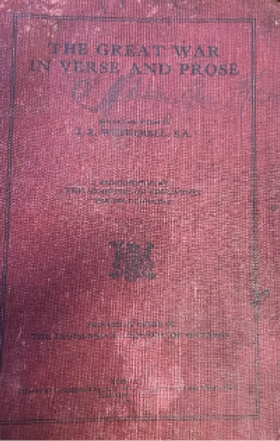
The Great War in Verse and Prose
This book was created in 1919. It includes a variety of the poems that were created during World War I, including some poems by Lieutenant-Colonel John McCrae. John McCrae was a Canadian doctor who served during WWI. He is most notable for his poem “In Flanders Fields”.

In Flanders Fields
By John McCrae
In Flanders fields the poppies blow
Between the crosses, row on row,
That mark our place; and in the sky
The larks, still bravely singing, fly
Scarce heard amid the guns below.
We are the Dead. Short days ago
We lived, felt dawn, saw sunset glow,
Loved and were loved, and now we lie,
In Flanders fields.
Take up our quarrel with the foe:
To you from failing hands we throw
The torch; be yours to hold it high.
If ye break faith with us who die
We shall not sleep, though poppies grow
In Flanders fields.
The Anxious Dead
John McCrae
O guns, fall silent till the dead men hear
Above their heads the legions pressing on:
(These fought their fight in time of bitter fear,
And died not knowing how the day had gone.)
O flashing muzzles, pause, and let them see
The coming dawn that streaks the sky afar;
Then let your mighty chorus witness be
To them, and Caesar, that we still make war.
Tell them, O guns, that we have heard their call,
That we have sworn, and will not turn aside,
That we will onward till we win or fall,
That we will keep the faith for which they died.
Bid them be patient, and some day, anon,
They shall feel earth enwrapt in silence deep;
Shall greet, in wonderment, the quiet dawn,
And in content may turn them to their sleep.


Antique Bonnet
Empire Day in Athens
Empire Day was on May 24th, 1919. This was the day the Township of Athens planted maple trees on the grounds of Athens Town Hall, in memory of the brave men who gave their lives in the Great War. These men were from the village and the vicinity. The tree planting was supervised by Reeve M. B. Holmes, warden of Leeds and Grenville.

Bloodletting and Mr. Booth
Blood letting was a technique used on sick people to “get all the bad blood out”. The little knives on the end would slice through your skin, helping the “bad blood” escape. One of the issues with this technique was many people were dying due to the amount of blood that was breaking free from the sick blood was a major issue. Blooding began 3000 years ago in the Egyptians and started to slow down in the 19th century. Dr. Booth, Athens and Forth ton doctor, who ended bloodletting in Athens by his creation of medicine from herbs he grew in his garden.


Historic Toys and Dolls

Santa Claus Doll
The body and hood of this doll are made of cotton, while the material of the face is rubber and the beard is made of synthetic fibers. Its features were typical of the handmade dolls produced in North America during the post-war period, inspired by the popular mid-20th-century image of Santa Claus. This doll belonged to Joan Ferguson, born in 1957, with a rare condition called “Osteogenesis Imperfecta”. The family’s doctor, Dr. Mainse, cared for Joan through every fracture and gave her this doll, which she kept on her bed for her entire life.
Regal Toy Company’s history:
“Vintage Santa, by Regal Toys Canada.” Campbells Online Store, 22 June 2025, www.campbellsonline.com.au/product/vintage-santa-by-regal-toys-canada/.


“Twin Tunnel Trains” Toy
Twin Tunnel Trains is a tin lithograph clockwork toy produced by the British company “Mettoy Plaything”. It represents the post-war English production of sheet metal toys. It consists of a tin base with a circular track; two plastic trains go around it and an airplane circles overhead. The toy in question is missing the airplane and the key that makes the mechanism work.
History of Mettoy:“Mettoy, Mettoy Playthings, UK Metal Toy Manufacturer (1932-).” The Brighton Toy and Model Index, www.brightontoymuseum.co.uk/index/Category:Mettoy. Accessed 18 Dec. 2025.


“View-Master” Stereoscope
Sawyer’s View-Master Stereoscope Model C, made of black bakelite with glass lenses, allows to watch 3D images using circular cardboard reels. It is one of the most recognised View-Master viewers, it was produced from 1946 to 1955 and was used originally as an educational tool for viewing images of famous place. With it there are two reels and their sleeve.
View-Master’s history:“View-Master.” Wikipedia, Wikimedia Foundation, 11 Nov. 2025, en.wikipedia.org/wiki/View-Master.


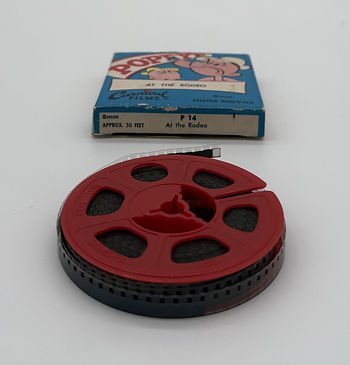
“Popeye at the Rodeo” Film
This is a film in 8mm format, called home movie, from “Carnival Films Inc.”. The original cartoon “Rodeo Romeo”, starring the character Popeye, was produced by Famous Studios and distributed by Paramount Pictures. In the 1950’ and 60’, 8mm film was one of the few ways to watch cartoons and films at home if you had a projector, many of these titles were sold in dime stores at modest prices.
History of Carnival Films:
Stanchfield, Steve. “A Who’s Who Guide to Home Movie Cartoons – Part 1: Carnival Films!” A Who’s Who Guide To Home Movie Cartoons – Part 1: Carnival Films! |, 2017, cartoonresearch.com/index.php/a-whos-who-guide-to-home-movie-cartoons-part-1-carnival-films/. Accessed 16 Dec. 2025.
Plot of the short movie:
Sailorpedia, Contributors to Popeye the. “Rodeo Romeo.” Popeye the Sailorpedia, Fandom, Inc., popeye.fandom.com/wiki/Rodeo_Romeo. Accessed 16 Dec. 2025.


The Origin of Home Children
From 1869 – 1940's over 100,000 children came to Canada from Great Britain during the Child Emigration Movement, it is estimated that 12% of the Canadian population are descendants of Home Children. Children found themselves in this situation by either not being able to survive without public support due to the death or poverty of their parents, or criminal behaviour. The options for these children were often either an institution, or emigration and the opportunity for a better life. Both the Canadian and British government supported this program, the requests by Canadians for children almost always outnumbered the number of children available.
In most cases the evidence suggests that the majority of children were treated well, the children were supposed to receive as much education as possible and attend church regularly. But abuse of the system did exist, with little to no follow up, and most often in an isolated rural area where farmers were free to treat the children as they pleased. Lots of children worked dawn to dusk, who had previously known nothing, but the city streets were expected to milk cows and tend fields, many never saw the inside of a church or school. Some slept in barns and were beaten, neglected and molested.
Their Stories
- A Selection -
Marry Potter
Mary Potter was adopted by Willard and Lucy (nee keck) Collision, who had no other children. They lived on a small six-acre farm. Mary potter was four years old when she travelled from Glasgow, Scotland aboard the ship Siberian in 1896 as a British Home Child under the quarries orphan homes program. She arrived in Quebec, then to the Fairknowe Home in Brockville and later to Iroquois.
Tommy Lightfoot
Tommy Lightfoot was employed at various farms In Athens after moving from Scotland and returned to Scotland with Scotty MacLean to visit family.
Jimmy Paterson
Jimmy Paterson, a Home Child employed for seven years, beside the Athens Home Child Monument that he placed. Les Deville was a local WWII veteran who came to Canada as a Home Child. Many Home Children like Deville were quick to enlist, as their homeland needed defending.
Scotty MacLean
Scotty MacLean, one of the most famous Athens Home Children. He was the chief of police for many years in Athens. He enforced the law with firmness, impartiality, and common sense. Scotty who began his life in Canada with extraordinarily little, he certainly contributed and was incredibly involved with the community. Scotty MacLean was born in 1914 in Kirkintilloch, Scotland, he came to Canada as a Home Child in 1930.
Hand Drills and Bits
Maple syrup! Have you ever wondered what they used back in the day to drill maple syrup trees? Or where did the concept of drilling into a tree to get maple syrup come from? The image pictured at the Historic Museum in Athens is a collection of antique hand tools typically used for woodworking, as well as drilling holes in maple trees during maple syrup season. Pictured below, is an antique brace and bit made with a combination of a steel bit and wood for the carved handle. The first versions of these tools were originally made from entirely of wood, which made them a lot lighter than the metal ones, and likelier to break due to the intense pressure they would endure during work as well as being made solely of wood. Some of the common woods that were used to create these tools include Beech, Birch, and Brazilian Rosewood. The wood provides a comfortable grip and feels warmer than the touch of metal. The frame (U- shaped crank) and bits are made from steel; the steel provides durability and strength for drilling. While electric drills are very common today which make jobs simpler, the brace and a bit were used for their precision and control particularly in traditional wood working or situations without power, these hand tools are important because they made jobs back then easier and were crucial for the advancement of maple production. The exact place where these tools were from and manufactured is not available.
If you were to venture to Edgewood Farms in the early spring months, you may have the chance to experience the historical use of tapping a maple tree with the traditional brace and bit! This is where I first learned of the traditional maple syrup methods and the evolution of maple syrup.


1962 Jacket and Football
In these photos there is a football and a leather jacket. The context behind these items date back to the 1962 Athens DHS football team. These items belong to Tom Flood, and Athens District High School graduate who was part of the football team in 1962. The jacket is a yellow leather jacket with a collar and blue stripes on the sleeves; it has his number as well as his name shown on it. The inside of the jacket is plaid and says "Tom Flood" on the tag. There is also a patch that says his name, as well as EOSSA champions 1962. It is in good condition. The football is also leather and has stitched on laces. It says EOSSA Champions and “Athens ADHS” on it. It was made by Spalding. Its condition isn’t as good as the jacket, as it has lost its traction and is quite worn in and flat. These items can be found at the Athens Museum, as they were donated by Flood.


The Legend of the "Witch" of Plum
Elizabeth Barnes, the “witch” of Plum Hollow, was disowned by her parents after she eloped to Canada from her home in Ireland. Her first husband passed away when she was in her early 20’s. She remarried soon after. She had nine children with her second husband. Unfortunately for the family, her second husband left her and their children and did not come back. Elizabeth Barnes was left to provide for her family alone. She decided to tell fortunes to locals. Allegedly, John A. Macdonald came to see her, and she foretold he would become the leader of a country, who’s capital would be Bytown (Ottawa).


Painting Backdrop
Crawford Slack was considered a "renaissance man" of Athens. Crawford was a talented singer, poet, musician and folk painter who excelled in these skills from a young age. He found beauty in everyday life, frequently painting local landscapes and writing poetry in the "language of the common folk", as seen in the following excerpt, which Slack is believed to have written -
"Needn't talk ter me 'bout livin' in the city
with its show, Druther live 'mong these
surrounding's where the folks are rather slow ...
Where the golden summer sunset glids the
village church's dome - There among the
slantin' shadows, I would druther have my
home."
This poem reflects his love for the small village of Athens, Ontario, which he called home.
This backdrop painting discussed here depicts Jones Falls near Elgin. It was painted by Slack in the 1920's and was kept for many years at the South Crosby (Elgin) Community Centre, behind the stage. It was later donated to the Athens and District Historical Society.
