
The History of the Ivesons
Written by A.D.H.S. student Lilly Taylor (family member)
In 1856, the Iveson family settled in Metcalfe, Ontario, a small part of the Osgoode township outside of Ottawa. Leaving his family’s successful saddlery business in Rochdale, England, Timothy Iveson came to Canada with two of his sons, his wife and the rest of his children to come later. Metcalfe was small and housed only a few families. That was until Timothy settled there, establishing a new saddle and collar shop. Within only a few decades, the Iveson family quickly grew as one of the most influential families in the area, and Metcalfe grew with them. Timothy’s son, Frank, became a clerk and treasurer in the Osgoode municipal government. He also ran the telegraph, post office, fire bell and, later, rural telephone out of his home, making the Iveson house a pillar of the community. Frank also perfected Timothy’s invention, the Scotch Collar. It was an improved type of horse collar that decreased strain on the horse’s neck. This collar was reportedly shipped all across Canada, and it would have significantly impacted many small farming communities in the area. Another of Timothy’s sons, Henry, took over his saddlery business and ran it until he passed away in the 1930s, closing the shop for good. Influenced by the Ivesons, Metcalfe grew, and it quickly became one of the main stops on the way to Bytown (now Ottawa). Frank’s children continued to make big waves in the area. They worked in the post office and learned how to operate the telegraph. There are even stories of when his daughter, Mae, translated a message from London saying that Queen Victoria had passed. Within minutes, the church bells were ringing to alert the town. His eldest daughter, Sadie, became a teacher and acted as principal in the Metcalfe Continuation School in the 1910s. His youngest daughter, Frances, followed in her sister’s footsteps and worked as a teacher then as principal in Ottawa, 1956, becoming one of Ottawa’s earliest female principals. She was well known for her influential leadership and passed in 1991, a well accomplished woman.
The Iveson family made significant impacts on Metcalfe and this area of Ontario. Like so many other families, they came to this area as ordinary people looking to start a new life, and ended up creating big change, and it is people like them that, little by little, shaped the communities we know today. In this section, you can learn about some artefacts from the Iveson family, including some emotional letters that were sent to Frances Iveson from her good friend Elmo Sully during WWI.
Timothy Iveson


Timothy Iveson came to Canada from Rochdale, England in 1854 with two of his sons. His wife, Ellen Allison, and their daughters joined them later. He left the Iveson family business in Rochdale which began as a saddlery, but later became a popular department store. Timothy built a house and set up a new saddlery in Metcalfe, Ontario. Along with his store, Timothy is also credited with being Metcalfe’s first school inspector and held the first library in his house. He also installed Metcalfe’s telegraph in his house, which was later operated by his son, Frank Iveson.
Timothy Iveson was not just a gifted saddler; he also had a love for education and poetry, even writing some poems of his own. This is a poem he wrote about the telegraph that was set up in his house in Metcalfe:
“The telegram, on wings of light, charged by celestial fire,
Flash from our office as we wish, on insulated wire;
Convey our thoughts, and theirs to us at very small expense,
Two hundred miles away and more for only fifteen pence.
Sickness and death we oft announce to friend that’s far away,
Sometimes the merchant asks for goods and sometimes asks for pay.
We often feel we know too much, for some we dare not tell;
Their messages we send away and keep the secret well.”
How Timothy ended up in Metcalfe is an interesting story, and as it turns out, Metcalfe was never his plan. He had intended to go to Guelph, but a gentleman at the ticket box, a Mr. Lemming, who owned a shop in Montreal and another in Kemptville, told Timothy about a spot for a business in Kemptville. Mr. Lemming told him to go to his house in Montreal, and he would take him to Kemptville, but by the time the gentlemen arrived nine weeks later, the spot for a business had been taken. Timothy then heard about a place to stay in Kenmore, so he began a 25-mile trek on foot, and on the way, he met another man walking to Metcalfe. The man asked Timothy where he was headed, Timothy replied
“To Kenmore, to start a Saddlery”, and the man told him he would do no such thing. He would stay right there in Metcalfe.

Timothy's daughters
Timothy Iveson's Work Bench
This is an early 1900s work bench that Timothy would have made for his saddle and collar maker shop. The bench is made of wood and leather and includes a seat and a tray for his tools.


Timothy Iveson's Horse Collar
This is an example of the collars that Timothy made in his shop. This collar was called the scotch collar. Though the scotch collar was later perfected by Timothy’s son, Frank Iveson, it was invented by Timothy. It was a special collar that relieved strain off the horse’s neck, and it was reportedly shipped far and wide. This is a quote from the Osgoode Township Historical Society and Museum newsletter, 1991:
“The Iveson “Scotch Collar”, famous for its relief to horses’ sore shoulders, was shipped all across Canada.”


Article About Iveson Department Store in Rochdale

This is a newspaper article, published in 1952, that shares some of the history of the Iveson department store in Rochdale. This store started as a humble saddlery, which is what it was when Timothy left in 1854. Afterwards, it grew into a huge department store that served the entire town of Rochdale.
Timothy Iveson's Lamp
This lamp was owned by Timothy Iveson. It was originally an oil lamp, and it has beautiful engravings on the metal parts, and a lovely winter scene painted on the middle. The design includes three beetles engraved into the metal, and floral patterns. The lamp is a good example of Victorian era parlor lamps.


Timothy's Pocket Watch
This pocket watch was given to Timothy Iveson by the Baptist Society of Rochdale before he immigrated to Canada. Along with the watch, there is also a glass case where the watch can hang when it is not being used, and a small gold coloured piece as well. The watch is a silver colour with floral designs and engravings, and there are two markings stamped onto the top. These marking are British Hallmarks, which were used to show the gold/silver content in a piece as well as the time it was made among other things. The markings on this watch likely signifies that the watch is 95.83% pure silver and was made in the 1850s.


Henry Iveson
Henry Iveson was one of Timothy’s sons. After Timothy passed, Henry, (sometimes known as Harry), took over the Iveson saddlery in Metcalfe and ran it until he passed away in the 1930s, when the shop closed down.


Henry's First Pocket Watch
This was one of Henry Iveson’s pocket watches. It is an “American Waltham” watch which was a famous watch company founded in 1850 by Aaron Lufkin Dennison. It was likely made out of gold and has floral designs.


Henry's Second Pocket Watch

This was another one of Henry Iveson’s pocket watches. Connected to it is a leather loop that Henry made to hang it in his shop in Metcalfe. It also an “American Waltham” watch and has floral designs and engraving. The watch is stored with a small note from Frances Iveson confirming who the watch belonged to.


Frank Iveson


Frank Iveson was one of Timothy’s sons and came to Canada when he was six. He took over the Iveson house when he was older, and with that he ran Metcalfe’s telegraph, post office, fire bell, and rural telephone. He was also a Clerk and Treasurer in the Osgoode township and led the Metcalfe band for a while. He also knew the practice of saddle and collar making. Before his work in the Metcalfe municipal government, Frank was part of the 47th regiment, Carleton Country, and he fought in the Fenian Raids in Prescott. His participation in the army allowed him to perform the bugle on Parliament Hill, July 1st, 1867. The very first Canada day.
Frank was also well known in Metcalfe for his love for horses. He was the only one to perfect the famous Scotch Collar, but he mostly left the trade when he started working with the municipal government. There are several accounts saying however that it took only the mention of a horse’s sore neck, and Frank would work past midnight making another Scotch Collar.
Frank's Band Paper
In the late 1800s and early 1900s, Frank Iveson was a leader of the Metcalfe Band in Osgoode Township. He was also associated with the Metcalfe choir, both of which operated out of the Metcalfe Baptist church. This paper shows the program for a Metcalfe band performance on one side, and on the other side there are song lyrics for the choir. This paper is a part of the collection of artefacts from Frank Iveson. The paper is very worn and fragile.


Results of a Bylaw Election
This paper shows where Frank Iveson tallied up the votes from a bylaw election to raise $2500 for an unknown reason in 1891. The results are then signed by Frank Iveson, Clerk.

Invoice from Saddlery
This is an invoice from the Iveson saddlery in Metcalfe, Ontario, signed by Frank Iveson. It shows a purchase made at the saddlery in 1895 including two harnesses and a horse collar.

Frank's Diary Page

This is a page from Frank Iveson’s diary. It is very torn and fragile, with some of the writing still legible, mentioning a trip he took to London.

Iveson Post Office Box
This is the mailbox that would have been in the Iveson house, along with the telegraph and rural telephone. It says, “Post Office Delivery” and was the spot where letters could be dropped off for Frank Iveson to sort. It is still in great condition.


Frank's Stamp

This stamp was used by Frank Iveson when he was Metcalfe’s Clerk and Treasurer. The wooden stamp is very stained by black ink, and the stamp says, “Return in 10 days to F. Iveson Clerk & Treas. Township of Osgoode Metcalfe, Ontario”.

Frank's Bible
This was Frank Iveson’s bible, which he had personalized and stamped with his name on the front cover. This could have shown Frank’s high status in the town. The bible was published by “Thoms Nelson and Sons”, a Christian publishing firm that began in Edinburg in 1798.


Frank and Elizabeth's Marriage Certificate
This is the marriage certificate of Frank Iveson and his wife Elizabeth York Iveson. They were wed on May18, 1878.

Mae Iveson

Mae Iveson was one of Frank Iveson’s daughters. As a child, she learned how to operate the telegraph, and often worked in the post office to help her father. She later met Ernest Anderson, and married him, moving to Lindsay. Working with the telegraph, Mae often received important news, and there is a story of how she was eating in the kitchen, her mother’s bean soup, when a telegraph came in. She translated it and discovered it was news from London. Queen Victoria had died. Within minutes, the church bells in Metcalfe were ringing to spread the news.


This is a photograph of Mae Iveson playing in the snow wither her sister Frances and her fiancé Ernest Anderson.

Frances Iveson

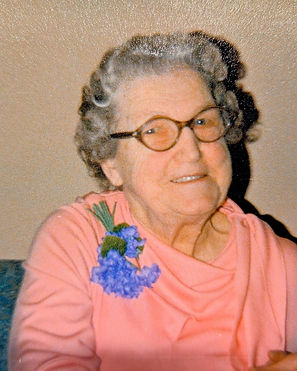
Frances Iveson was the youngest daughter of Frank Iveson. She is known for the letters she received from her good friend Elmo Sully in WWI, which were transcribed into a book and sold by the Osgoode museum. She was also a dedicated and well-respected teacher in Ottawa and later became one of Ottawa and area’s earlier female principals in 1956. Frances Iveson was dedicated to her family history and genealogy and before she passed, she donated many of her family artefacts to the Osgoode museum and Upper Canada Village. Most artefacts you will see in this section are from the collections at one of these museums.


This is a photograph of Frances Iveson as a child with her nephew.

Frances's Birth Certificate

This is the birth certificate of Frances Iveson, signed by her father Frank Iveson. She was born November 19, 1899, in Metcalfe, Ontario. The certificate shows that her legal name is Fannie, and this is a name she used when she was young, however when she was older, she was only known as Frances.
Principal Iveson's Message

This is an announcement that Frances Iveson wrote to her students as principal of Riverview School in Ottawa. In the message, Frances emphasizes the need for school and learning, and encourages her students to do their best, reminding them that they are the future.
Frances's Retirement Card

This is a retirement card that was given to Frances when she retired as principal of Riverview School. It was given to her from the Ottawa Public School Women Teachers’ Association.

France's Letter of Congratulation
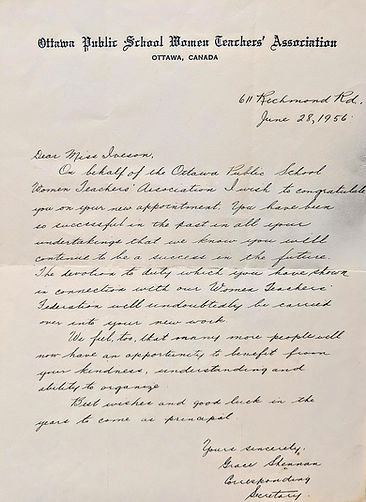
This is a letter written to Frances Iveson from the Ottawa Public School Women Teachers’ Association, congratulating her on her new position as principal. It was written in 1956.
France's Watch
This is a watch that was given to Frances Iveson when she retired as principal at Riverview School. It is a vintage Birks watch, made of 14k gold and a crystal face. It was a very generous gift and showed the respect and appreciation that the school had for Frances.


France's Christmas Card
This is a Christmas card that one of Frances’s school friends, Duff Crerar, sent to her while overseas during WWI. The card is very fragile and is falling apart in places.


Private Sully and friends

Elmo Sully
These are some of the letters that Private Elmo Sully sent to Frances Iveson during WWI. They are a collection of British Expeditionary Force letters and post cards. Private Sully was also from Metcalfe and was a very good friend of Frances Iveson. He had tried to enlist in 1915 at only 17, but the army found out he was underage and made him wait until he turned 18 to go. In these letters, Elmo talks about his experience at training, and then on the front lines during many battles including the battle of the Somme. Though he suffered a bad blow to the head, Elmo survived the war and went on to attend Queens University for engineering.


This is a historical fiction written about Elmo's time in the war. It is based off of the letters written between Elmo Sully and Frances Iveson. The story contains real people from Metcalfe, including not only Elmo and Frances, but also Charlie Goodwillie, who really did die in service. Throughout the story, there are direct quotes from Elmo’s letters, including the part where he sent Frances flowers before battle, as well as the mention of the hymn that the community of Metcalfe sang as their boys came back home after the war.
Elmo Sully and His Wartime Girl
December 1915
“I will go to war! I will be a hero! Just you wait!” Elmo Sully shouted at his neighbour,
Charlie Goodwillie, who chuckled and teased him. It had been over a year since war broke out,
and it was all the local boys of Metcalfe, Ontario, could talk about. They dreamed of joining the
war and finding glory far away, and Elmo, though he was only seventeen, was certainly no
exception. He was determined to be a soldier, but try as he might, he was just too young to go.
“Y’ur not goin’ anywhere,” Charlie scoffed, who was four years older and ready to enlist
himself. Elmo’s face turned red with frustration, and he was about to shout back when someone
grabbed his hand.
“Don’t fight with Charlie, he’s only joking,” said Fannie Iveson, one of Elmo’s dearest
friends. “You will be a hero, Elmo,” She comforted him. “Just you wait.”
April 1916
“He did it, he’s really going,” Fannie recounted the events of the day to her mother,
Elizabeth Iveson. It was that day that Elmo came to her with the news. He had finally turned
eighteen, he was finally going to war.
“What if something happens to him? He’s still so young. Perhaps he should wait,” Fannie remarked.
“Keeping that boy from going to war would be as hard as dressing a pig!” her mother
joked. “Besides, Elmo is smart, and strong too. He will be fine.” Elizabeth studied her daughter’s
forlorn face, and her heart went out to her.
August 1916
Dear Fannie, I am enclosing some flowers. Hope they aren’t too wilted when you get
them. Elmo was busy writing, frantic to finish before curfew. After training for months, today
was his last day in England before shipping out. Elmo knew of Fannie’s fears as he headed into
battle, and he hoped that some flowers would cheer her up. The thought cheered him up. Charlie,
who had been fighting for four months, had sent Elmo a letter of teasing and encouragement in
attempt to lift his spirits, and now Elmo was filled with anxiety and excitement. The day he had
been waiting for was finally coming.
September 1916
“Fannie, don’t you think these should be thrown away?” Elizabeth pointed towards the
vase of flowers sitting on the chest. Their leaves were brown, their petals drooped, yet Fannie
loved them as much as she did when they arrived.
“Of course not,” she insisted, “those flowers will stay as long as Elmo is gone.” To
Fannie, the flowers weren’t just a gift, they showed her friend’s thoughtfulness and hope, and she
vowed to treasure them until he returned. Elmo had been away for many months, and despite
Fannie’s busy schedule, the studies that kept her occupied as she tried to stay top of her class,
Elmo remained in her thoughts, day after day, and his gift gave her the hope she needed to carry
on.
November 1916
“Elmo? Elmo! Wake up!” Someone was shaking him by the shoulder.
I’m trying, he thought, but no words came out. All he felt was pain, a terrible stinging.
He reached up to feel the wound on his forehead.
“He’s alive!” another voice shouted, and Elmo soon felt himself being lifted off the
ground and onto a stretcher. He tried to open his eyes, but the world looked blurry. It made his
head pound. As he was wheeled away, he heard someone whisper.
“He was blasted by a shell, he’s lucky to be alive.”
January 1917
“It’s from Elmo, oh thank the lord!” Fannie shouted as she ripped open a letter. Many
weeks ago, she’d learned of Elmo’s injury, and she was desperate to hear from him. “He’s been
released from the hospital. He’s going to be fine!” Fannie sighed aloud as she scanned the letter.
She closed her eyes and silently prayed. Dear God, thank you for protecting Elmo, now please
just send him home!
October 1919
“Oh God, our help in ages past, our hope for years to come, our shelter from the stormy
blast, and our eternal home!” The people of Metcalfe sang with celebration, welcoming their
boys back home. The war was over! Fannie and Elmo stood side by side. They sang with the
crowd, for their friends who returned home, for the ones who didn’t. Charlie had died in battle,
and as tears welled in Elmo’s eyes, Fannie knew he was thinking of him, and of all the others.
She recalled what he had said to her after his return.
“I’m lucky,” he said. “I shouldn’t have lived.” She took his hand and held it tight as she
whispered.
“You are a hero Elmo, and so are they. Never you forget.”
Jane Iveson's Shawl
This shawl was handwoven by Jane York. Formerly Jane Iveson, she was one of the sisters of Frank Iveson, and lived in Metcalfe, Ontario. It is made of dyed wool, in green, red, black and tan colours, and it has fringing around the edges.


Sadie Iveson
Sadie Iveson was Frank Iveson’s eldest daughter, and she was a very successful teacher and principal in Metcalfe, Ontario, before she married. She worked for many years at the Metcalfe Continuation School and would have taught many local students including some of her own siblings. In the letters from Elmo Sully, who was also one of her pupils, she is mentioned often. She later acted as principal of the school and was very well respected. This is a letter, addressed to “whom it may concern” written by the chief of the board, detailing Sadie’s great work at the Metcalfe school. The letter was sent in 1914. In the early 1900s, the percentage of female principals in Canada was very low, and it was women like Sadie who helped raise that percentage and make that role more accessible to women.


This is a photograph of Sadie as a child and her class in Metcalfe.
The York Family
Frank Iveson’s wife, Elizabeth York Iveson, is a daughter of William York, the first white settler in Osgoode. He left his home in Sussex, England in 1824, came to Cornwall, then settled in what is now the Osgoode township. He created York's Corners and Springhill, areas near Metcalfe. The family later became known as the Springhill family.


Photographs of Elizabeth York

Photograph of Thomas York

The York family
Iveson Tools
Iveson Pricking Irons
These are pricking irons that were used by the Ivesons in their saddlery. They would have been used to mark evenly spaced holes along leatherwork before sewing. One of them has “Thomas Adams” stamped on it. Thomas Adams is stamped on many tools and was likely the manufacturer of them.


Iveson Stitching Awl
This is a stitching awl that was used by the Ivesons in their saddlery. It would have been used to create or enlarge holes in thick leather.

Iveson Soldering Iron
This is a soldering iron that was used by the Ivesons in their saddlery. It would have been used to crease edges or seal leather.

Iveson Burnishing Tool
This is a burnishing tool that was used by the Ivesons in their saddlery. It would have been used to smoothen or finish leather pieces.

Iveson Rotating Leather Hole Punch
This is a rotating leather hole punch that was used by the Ivesons in their saddlery.

Iveson Stamp
This is a stamp that was used by the Ivesons in their saddlery to mark leather pieces. It says “Iveson”, and has another initial that looks like it could be either T. or F. It was likely T. at first for “Timothy” but was later changed to F. for “Frank”.


Iveson Draw Gauge
This is a draw gauge that was used by the Ivesons in their saddlery. It would have been used to cut straight lines through leather.


Iveson Hammer
his hammer was used by the Ivesons in their saddlery.


Iveson Leatherworking Palm Iron
This is a palm iron that was used by the Ivesons in their saddlery. It would have been used to help push large needles through thick leather.
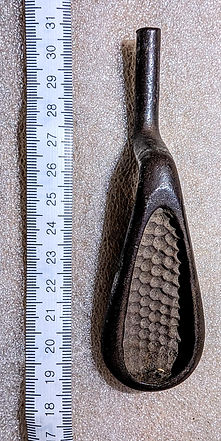

Iveson Screw Creaser
This is a screw creaser that was used by the Ivesons in their saddlery. It would have been used to create straight lines or stitching guides on a piece of leather.


Iveson Stamp
This is another stamp that was used by the Ivesons in their saddlery. This stamp would have used to mark the family’s tools. This is evident because the stamp perfectly matches the “Iveson” marks on other tools.


Iveson Cutting Nippers
These are cutting nippers that were used by the Ivesons in their saddlery. They would have been used to cut nails or wire.


"T" Stamp
This is a stamp that was used by Timothy Iveson in his saddlery. It would have been used to mark the pieces that he made.


Iveson Nail Tack Puller
This is a nail tack puller that was used by the Ivesons in their saddlery. It has a small mark on it that says “Osborne”. Many of the Iveson tools were made by C.S. Osborne & Co.

Iveson Leather Hole Punch
This is a leather hole punch that was used by the Ivesons in their saddlery.

Iveson Compass
This is a compass that was used by the Ivesons in their saddlery to make perfect circles.


Iveson Pliers and Hammer
This is a tool that was used by the Ivesons in their saddlery. Most of the tool looks like a pair of pliers, then it has a heavy metal piece attached to the top that would have worked as a hammer.

Iveson Stamp
This is another stamp that was used by the Ivesons in their saddlery to mark leather pieces. It is very worn down and difficult to read.


Iveson Screwdriver
This is a screwdriver that was used by the Ivesons in their saddlery. Near the top of the tool, it is stamped with “Pat’d Mar. 25. 1890”.


Iveson Knife
This is a knife that was used by the Ivesons in their saddlery. It would have been used to cut through thick leather.

Iveson Pick Tool
This is a pick / hammer that was used by the Ivesons in their saddlery.

Iveson Mallet
This is a mallet that was used by the Ivesons in their saddlery.

Many thanks to the Osgoode Museum and Upper Canada Village, where much of the Iveson family collection is currently located.