Old Map of Brockville created by the Department of National Defence
Original Survey 1905, Resurveyed 1938, Reprinted 1940
Contributed to the site by Bruce Jones.


The History of Brockville, ON

“BUELL, WILLIAM (1792-1862) – Dictionary of Canadian Biography.” Dictionary of Canadian Biography, 2026, www.biographi.ca/en/bio/buell_william_1792_1862_9E.html. Accessed 16 Jan. 2026.
Brockville was first settled in 1785 by William Buell, a loyalist veteran who received a land grant and laid out a town plan by 1802. Early buildings were made from local stone, and the area was sometimes called “Buell’s Bay”.
1808 – the growing village was chosen as the site of the District of Johnstown’s court house and goal. The Court house opening in 1810, and the surrounding grounds became the current Court House Green. By 1811, a town plan showed 26 buildings, and the settlement was officially known as Elizabethtown.
The first resident minister, Rev. William Smart, arriving in 1811 and helping establish a presbyterian congregation on land donated by Buell. The village was renamed in 1812, the settlement was variously known as Elizabethtown, Williamstown, and Charlestown until after the War of 1812 as ‘Brockville’ in honour of general Isaac Brock.
By 1830, Brockville was influential enough to send its own representative to the upper Canada legislature, and In 1832 it become the first community in the province granted self- governing.
The city later became home to Canada’s first railway tunnel (1860) and the historic Brockville cemetery (1851) river and rial travel fueled its growth with and multiple daily steamship stops and grand trunk railway service beginning in 1855.
Brockville railway tunnel
Was built beneath downtown Brockville as the first railway in Canada in 1854 and completed in 1860. It was constructed to provide access to the St. Lawrence from Ottawa to Brockville and was acquired by the city of Brockville for one dollar in 1983. After a century of being in use it was put to close in the 1970s and now operates as a free historic attraction with a sound and light show.
Fulford place
Built between 1899 and 1901 for Senator George Taylor Fulford, who made his fortune from the patent medicine “pink pills for pale people”. The Fulford family including Georges wife Mary has lived there using it both as a residence and a summer home. The mansion was often used to entertain high public figures such as the Canadian Prime Ministers and British princes. After his death in 1905, his family continued to use the place and later donated the property to the Ontario heritage trust in 1991.
Pink pills for pale people
Was a late 19th century patent medicine containing primarily iron. It was marketed by George Taylor Fulford’s company and was sold as a cure-all associated with paleness, including anemia. The main ingredients were iron, potassium carbonate, magnesia, powdered liquorice, and sugar. The claims this product could treat were a wide range like anemia, clinical depression, poor appetite, lack of energy, eczema, rickets, and even paralysis. While the iron content was in fact beneficial for anemia the products exaggerated claims caused the product to later be pulled from the market.
St. Lawrence
The area was first inhabited by the St. Lawrence Iroquoians which were known for their horticulture and the longhouses that would trace along the St Lawrence River. They lived in villages and heavily relied on their land for the cedar, fir bark and also as a place for their agriculture practices such as the three sister’s diet.
The St. Lawrence served as a vital transportation route for the indigenous peoples and continued to be crucial for trade and communication during the European settlement.
The St. Lawrence River in Brockville became a very popular stop for steamships which was taken advantage of for the industries that were developed on the waterfront such as breweries, trade, foundries and more. The river had shaped the development of Brockville, its economy, cultural identity, and the beauty over the centuries.
The Brockville and Ottawa railway further enhanced the city’s popularity linking it to broader markets which highly contributed to its industrial growth.
Today, Brockville remains a key point along the St. Lawrence which allows for international shipping and access to the great lakes. It is a popular tourist destination offering boat tours and activities that captivate the importance of the river.
Brockville’s connection to the Thousand Islands
Brockville’s connection to the Thousand Islands region plays an important role in the city’s identity and development. Located along the St. Lawrence River, Brockville served as an eastern gateway and one of the earliest access points to the region during the 19th century. As steamboat travel expanded in the mid-1800s, tourists from Canada and the United States began visiting the Thousand Islands for their natural beauty, and Brockville quickly grew into a key departure and arrival hub. By the late 1800s, the city was known as a prominent stop for sightseeing cruises, fishing expeditions, and leisure travel. This connection helped shape Brockville’s economy, supporting hotels, boat companies, and waterfront businesses. Over time, the city embraced its role as a cultural and recreational center for the Thousand Islands—a legacy that continues today through modern boat tours, waterfront parks, and heritage attractions that highlight its historic link to the famous archipelago.
Brockville Chemical and Superphosphate Company
In 1869 Brockville Chemical and Superphosphate Company had opened. The company prioritized its supply of fertilizers which were all locally mined ingredients. Originally they arrived in Canada to produce superphosphates and then later manufactured sulphuric acid. The road that had once led to the mine supplying the resources was known as Chemical Road but more recently renamed as Old Red Road. The company closed in 1884 when the supply was exhausted.
Nehemiah Seaman House
The Nehemiah Seaman house, built in 1816, stands as the first stone house in Brockville. It remains one of the community’s oldest and most historically significant buildings. The property was originally granted to Nehemiah Seaman, an early settler blacksmith and member of the first Presbyterian congregation. It highlights his role in shaping the young town and was designed to serve multiple purposes. The structure functioned as both Seaman's family home and his blacksmith shop, placing it at the center of early local trade and daily life. Over the years, the building adapted to the changing needs of the community - later becoming a saddle and harness shop, a confectionery and bakery, and eventually a well loved dairy bar. Today, the Seaman house continues to serve the public as a café, preserving its 200 year legacy as a welcoming gathering place and a tangible link to Brockville's earliest days.
Brockville Collegiate Institute
Brockville Collegiate Institute (BCI), originally known as Brockville High School, was founded in 1889, with its first grey stone building opening that September on its current Pearl Street site. In 1929, the original structure was destroyed by a fire, prompting the construction of the present Collegiate Gothic–style building, which opened in 1930. Over the years, BCI has undergone several major renovations, including a significant upgrade in the mid-1980s that added a new gym, expanded the library, and created new arts and cafeteria spaces. Another round of renovations in 2008 focused on restoring heritage features, such as repointing the brickwork and replacing the windows, while also modernizing the school’s technology. With a long and proud history, BCI also honours former students who served and died in World War I and World War II through its memorial honour rolls.
Shipwrecks
Brockville has a rich history of notable shipwrecks, including the schooner Lillie Parsons, which sank on August 5, 1877, after its 500‑ton coal cargo shifted during a squall, forcing the vessel onto a shoal near Sparrow Island. It now rests in about 65 feet of water, with much of its cargo still intact. Another major wreck is the Muscallonge, a large tugboat originally named the Vigilant, which caught fire on August 15, 1936. Despite the captain steering it toward shore to save the crew, the flames reached the fuel tanks, causing an explosion that broke the vessel apart before it sank East of downtown Brockville in roughly 95 feet of water, where parts of its boiler and engine remain visible to divers. Other significant wrecks in the area include the Robert Gaskin, lost during a failed salvage operation of the William Armstrong; the John B. King, destroyed by an explosion in June 1930; and the Rothesay, a wooden side‑wheel steamer that sank in 1889 and now lies only 300 feet from shore, making it one of Brockville’s most accessible dive sites.
Brockville Rowing club
The Brockville Rowing Club was founded in 1894 and is one of the oldest rowing clubs in Canada. Rowing in Brockville began earlier, in the mid‑1800s, with local crews racing on the St. Lawrence River. The club grew quickly after its founding, building its first boathouse in 1895 and competing in major Canadian regattas. Through challenges such as the World Wars and periods of financial difficulty, the club survived with strong community support. By the mid‑1900s, Brockville rowers were winning major titles, including victories at the Royal Canadian Henley Regatta, and the club eventually produced athletes who competed internationally. Today, the Brockville Rowing Club continues to train youth and adults and remains an important part of the city’s sporting history.
Ice storm of '98
In January 1998, Brockville was struck by the devastating Ice Storm of 1998, one of the worst natural disasters in eastern Ontario’s history. For several days, freezing rain covered the city in thick layers of ice, causing tree branches and power lines to collapse under the weight. The damage led to widespread blackouts, leaving many Brockville residents without heat or electricity during extremely cold temperatures. Roads became dangerous or completely blocked, and schools and businesses were forced to close. The Canadian Armed Forces were deployed to help clear debris, restore power, and support emergency shelters that housed families who could not safely remain in their homes. Although the storm caused major environmental and economic damage, Brockville’s community worked together to recover, making the 1998 ice storm a significant and memorable event in the city’s history.
Brockville Stories
Balloon Accident, 1874
On July 1, 1874, approximately 10,000 people gathered on the courthouse green to see Professor Squires and his balloon, The Atlantic. The balloon soon rose over the rooftops, but as the wind picked up, it crashed into the spire of the Wesleyan Methodist Church. The crash caused the professor to be knocked unconscious and left him dangling in the basket, 80 feet in the air. He was rescued by being pulled through a trap door in the church spire.
St. Vincent de Paul Hospital
November 1887 marked the beginnings of St. Vincent de Paul Hospital. Originally, the hospital operated out of Schofield House, located between Schofield and Lancaster Streets (now an apartment building).
In 1892, the hospital was moved to the corner of Garden and Pine Streets. The east wing was added in 1896, and by 1924, the nurses’ residence had become part of the hospital complex.
Further expansion in 1968 required the demolition of some of the hospital’s older buildings. The site is now part of Brockville General Hospital’s Garden Street location.
Quarrier Home Children
William Quarrier founded the Orphan Homes of Scotland in Glasgow around 1870. Soon after, some of these children were sent to new homes in Canada, often to work as farmhands. In 1888, Quarrier opened a receiving home in Brockville known as Fairknowe. This was where all the children arrived before being reassigned to homes across the country.
Between 1871 and 1935, approximately 7,000 of these “Home Children” came to Canada through the Quarrier organization.
Early Telephone Service in Brockville
In 1881, Brockville established its first telephone exchange. At the time, only 12 people had telephones, but the service grew quickly in popularity. By 1883, there were 45 subscribers in the city.
July 1, 1878
On July 1, 1878, Brockville hosted a soon‑to‑be‑famous athlete. Ned Hanlan took part in a regatta at the city’s well‑established Rowing Club. At the time, Hanlan was still working his way up the competitive ranks; just two years later, he would become the first Canadian to win a world championship in an individual sport.
Rowing regattas were popular spectator events in Brockville for many years.

“Doors Open Ontario | Digital Doors Open | Brockville and Area |….” Doors Open Ontario, 2026, www.doorsopenontario.on.ca/brockville-and-area-1/brockville-railway-tunnel. Accessed 16 Jan. 2026.

Wikipedia Contributors. “Fulford Place.” Wikipedia, Wikimedia Foundation, 16 Oct. 2024.

Camu, Pierre, and Roger William Benedict. “Saint Lawrence River and Seaway | River, North America.” Encyclopædia Britannica, 14 Jan. 2019, www.britannica.com/place/Saint-Lawrence-River.

Brockville’s Best | the Nehemiah Seaman House - Formerly Cowan’s Dairy Bar Building at Perth and King Streets, Now Richard’s Coffeehouse | Facebook.” Facebook.com, Facebook Groups, 2026, www.facebook.com/groups/brockvilleontario/posts/823792735676418/. Accessed 26 Feb. 2026.

“LILLIE PARSONS.” Down Too Long in the Midnight Sea..., 20 Sept. 2008, downtoolong.com/wrecks/by-location/great-lakes-wrecks/st-lawrence-river/lillie-parsons/. Accessed 17 Apr. 2026.

YMCA of Eastern Ontario and Brockville Rowing Club Partner to Deliver Summer Camps.” Ymca.ca, 2025, eo.ymca.ca/news/ymca-of-eastern-ontario-and-brockville-rowing-club-partner-to-deliver-summer-camps/2/258. Accessed 17 Apr. 2026.

“History of the St. Vincent de Paul Hospital in Brockville Ontario | Sisters of Providence of St. Vincent de Paul.” Providence.ca, 2020, providence.ca/our-story/archives-news/history-of-the-st-vincent-de-paul-hospital-in-brockville-ontario/. Accessed 17 Apr. 2026.
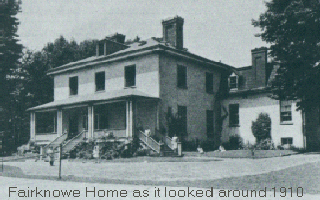
“History of Fairknowe Home.” Quarrierscanadianfamily.com, 2026, www.quarrierscanadianfamily.com/history.html. Accessed 17 Apr. 2026.

“Ned Hanlan.” Canadian History Ehx, 22 Oct. 2024, canadaehx.com/2024/10/22/ned-hanlan/. Accessed 17 Apr. 2026.