Sgt. Samuel H. Dunster

Samuel's Story
Born in Chard Sommerset England in 1884 to parents William and Susan Dunster , Samuel H. Dunster was raised Methodist. In 1912 at the age of 27 he decided he wanted to move to Canada for a better life and worked on ship for a ticket to Canada. Settling in Lyn Ontario he started building a life of his own. 1916 WWI had been around for 2 years now, and Samuel made the decision to enlist with the 156th Battalion out of Brockville Ontario at the age of 31 and only measuring 5 foot 3 inches. Sam fought in France and it was there he was injured taking shrapnel to the left hip. However, that didn’t stop him he was back fighting and discharged at the end of the war. WWII hit and now with a family of his own and lingering pain he was unable to serve overseas again so he became a chef making meals for the prisoners of war camps (POW camps). He still missed the uniform and decided to be a guard instead and by mid 1940 he was a member of The Veterans Guards of Canada. Spending the whole war semi locally as he was trained in Barrie field and ended up in Kingston Ontario at the end of the war. Samuel is recognized for his contributions during WWI and WWII and will forever be a solider of the Great War (WWI).
Written by A.D.H.S. history student Katherine Pattemore (family member).

The Beginning
Below is a photo of a scrapbook Made by the Dunster Family, It includes Samuel's birth certificate, a family photo in England in the 1890s and some facts about him and his family.

Attestation Papers
The Historical Papers These WWI Attestation papers are a huge part of the rich history and to have access to them has become very simple. Samuel H. Dunster was one of the many men and women who served in WWI, and these papers are proof of that sacrifice because, he signed these papers. Samuel was in perfect condition, coming back he was not so lucky leaving France with shrapnel in his hip not being able to walk properly again. The pain that he arrived home with and the history that was made makes these papers as important as ever.


This is a Primary Source photo ( a photo from the time) of Samuel in training at Barriefield in 1916. He is on the far right.

Training WWI
The Story of Samuel H. Dunster During WWI

In the Canadian military during WWI and WWII (they still do it to this day) you would get a portrait photo after your enlistment. This is what you're seeing today. Samuel H. Dunster got this photo in 1916 during WWI.

Life in the trenches in France during WWI was a grueling experience dealing with rats,lice and infections. Soldiers in the trenches also had to deal with the enemy firing at them. This is a primary source photo of Samuel Dunster in a trench in France getting ready to shoot. Samuel is the one with an x above his head to mark where he is.
The Papers of History
These might just look like a bunch of papers to the common eye, but these are historical documents only few have. The Great War, World War one and many more names are associated with this time. Private Samuel H. Dunster my great grandfather joined the military after moving to Canada from England and joined to be a solider fighting in and for Canada and the nation he called home. WWI was one of the hardest experiences for him as he lost his sister at quite a young age during his time in France and was unable to get leave to attend the funeral. My Grandfather did not survive the war unharmed as well, as he took heavy shrapnel to the left hip and was left to walk with much pain for the remainder of his life. These discharge papers symbolize the freedom my grandfather had and the beginning of the end for him at 34 years old he set out with these papers in hand to start his life and that he did. My grandfather served in the Veteran's Guard of Canada and these papers symbolize the end of the world wars, the end of the pain and hurt for my grandfather these papers were his life story, and I am honoured that I get to share them with the public today.


Honoured With a British War Medal

Leaving your home is a hard and emotional task nevertheless, Samuel Dunster went through it. This British War Medal symbolises more than just a service medal from WWI but absolute pride. Samuel H. Dunster served for the country he called home and this medal with his name and rank and what force he was in is a symbol of his courage. This medal was not the only one, there were 427,993 issued to Canadians in the Canadian Expeditionary Force (CEF) and 6,500,000 issued in total. True bravery and sacrifice is not going unnoticed and that is what this medal symbolises.

Front
Back
This 159th Battalion ring was gifted to those who fought with this battalion in WWI and as a surviving member of WWI and former member of the 159th Battalion Samuel H. Dunster was gifted this ring as a symbol of perseverance, hope and the sacrifices made.
The Ring and Pin of Hope and Sacrifice


When Sam signed up to be a veterans guard his family was in shock, he was 50 years old and sustained an injury in WWI. Sam signed up to guard prisoners, a gruelling task not for the faint of heart. He was discharged at the end of WW2 and awarded with a general service pin of service over 3 months this was his pride and joy the symbol that even wounded from battle he was capable then anything.
Samuel in WWII
WWII arrived and still with pain and memories of WWI, Samuel decided to join the Canadian Veterans Guards. The Canadian Veterans Guards was a regiment made up of older WWI soldiers that are unable to fight in WWII, those men joined as Guards for the Prisoners of War camps (POW Camps) on the homefront. There were many different jobs you could do 2 examples are a chef, a guard there are many other jobs however, those were the most common. Samuel Dunster was a chef during the start of WWII cooking for the inmates of the POW camps and a Guard as well. Samuel was transferred all over Ontario he even ended up in Kingston Ontario a now hours drive from his home.
Sergeant Samuel Dunster
Photo WWII (1940s)

WWII Canadian Veterans Guards of Canada Regiment Photo 1940s.

Sergent Samuel Dunster can be found in the back row sixth man
Samuel Dunster During WWII
Sergeant Samuel Dunster had many jobs as a Canadian Veterans Guard and went to many places. Below are primary source photos (photos from the time) from Samuel's time as a Veterans Guard. Also below are notes written to Katherine Pattemore (one of the many history students involved in this project) from her Great Aunt Nancy. The notes are about Katherine's great great grandfather Samuel Dunster and all the information needed for the photos attached.
Samuel as a Chef for the Prisoner of War Camps in Ontario on the Homefront During WWII (1940s)


Samuel can be found as the second man in the front row (left to right)
Samuel as a Guard during WWII in the POW Camps, Location is Unknown (1940s)


Samuel Dunster can be found on the far left of this photo taken in the Old Fort Henry

This is a picture of Samuel Dunster at The Old fort Henry. Sam can be found on the far left.

This is a note from Katherine Pattemore's aunt Nancy who helped her with lots of the research.

Samuel Dunster can be found in the front row, far left of this photo taken in the Old Fort Henry
The Veterans Gaurds of Canada's Weapon
The Canadian Veterans Guards of Canada were guards in the Prisoner of War Camps and did have weapons. During WWII much like WWI all the resources available were going overseas so the guards were supplied with one wooden baton used for self defence just in case.

The Stripes of War

WWI was tough and the loss was massive however, then WWII came into the equation. The art of war was a common knowledge by the time WWII came along; the loss of so many and the emotional and physical abuse it was took its toll. To show the years of service army personnel were given army chevrons. Those who fought in the Great War (WWI) for Canada. Samuel earned the rank as Sergeant (it is unknown how) but he did and that’s what the 3 bigger stripes mean.

Life After The World Wars

A Portrait taken of Samuel and his wife in 1953 by Lawrence Redman in Brockville Ontario.
Life after WWII was difficult for many, not for Samuel. Much happened after WWII with Sam's kids as some were marrying and the Dunster family expanding both Samuel and Luetta were busy keeping up with all the changes. One thing that never changed with Samuel and Luetta is the love and commitment they had for each other right until Samuel's death in 1963. Luetta was always by his side and she was always by his side.
This is a photo of Samuel's kids (all 9 of them) and their dog. The year is unknown.

This is a photo of Beatrice (third from the left) and her husband (second from the left) and Samuel (far right) and Luetta (far left) at Beatrice and her husband's wedding

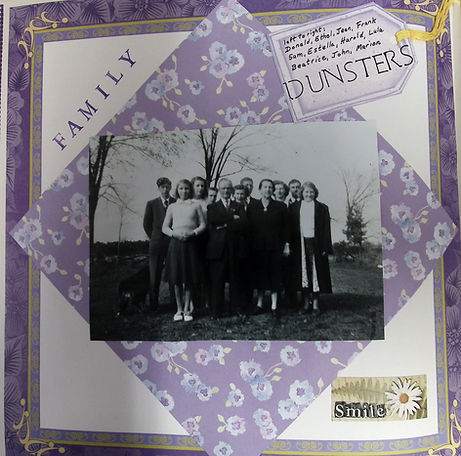
This is a photo of one of the many Dunster gatherings (reunion) and the size of our family. These still happen today (not as big on scale) however, they still are an important tradition we try to up keep. This get together was in 1963.
Samuel can be found in the second row 6th person in and Lula can be found second row 7th in (on the right of Samuel).
Duty on the Homefront
The Memories of War on the Homefront The Dunster family watches in sorrow as Samuel hobbles in pain down the lane to get in the army vehicle. Samuel Dunster looks back for a glimpse as he sees his children look, and his wife Lula just mutters to herself with one pleading look. He turns to leave with a sigh and advances to the jeep.
The Canadian Army called me one morning with the news of war. I couldn’t enlist, just walking was a chore for me. I could, however, guard prisoners and be useful. My wife, Lula was not on my side for that idea,
“You're not strong enough Sam,” stated Lula.
“Oh yes, I am and I’m going to go, my other family is not able to fight” Sam sternly answers back
“What about your children, Sam you're just going to leave us here, and leave your family”
She walked away, leaving me with my thoughts as I pondered my decision. I ended up enlisting as a Veterans Guard of Canada, and I was trained in Quebec at the age of 50 with my wife's disapproval looming over my head. I still think back to the looks my family was giving me on the day I departed, but I still proceeded to climb in that vehicle never looking back.
I was posted as a chef in Ottawa. To start my deployment, I made meals for the Prisoner of War and helped create a recipe known around Ontario as The War Cake. I was a guard after that and was transferred from Quebec to Petawawa and ended up in Kingston at Fort Henery. I entered Kingston with low expectations and met the prisoners I was to be guarding. It was hard, these men and boys were the same age of my kids at home, and they were trapped in this country that most of them would later call their home. I remember the day I was discharged from service it was a happy day, and the day I headed home. I was called into the office with the lieutenant sitting in his chair,
“Sergeant Samuel Dunster you are being discharged today at the account of the war is done.” Lieutenant Willam Stone booms
“Thank you, sir I hope, you have a future free of what we have experienced throughout these wars,” I bowed my head and headed towards the door, but was stopped by the booming echo of lieutenant's voice,
“You’re an inspiration to all Sergent Dunster, thank you for your service and time,”
I left feeling proud to be Canadian. I took the train home with some of my fellow comrades and got off near my home in Lyn. My wife was out doing the laundry when I started up the lane, with a smile and a nod she turned to yell for the children, I was home for good.**This story is a historical fiction based on real events
** This story was written by Samuel's great great granddaughter Katherine Pattemore a A.D.H.S. history student in this program. This story is to honour her grandfather and what he did for Canada. This story is based is fiction but based on factual evidence.