Bruce Wellington Huton
Everyday Man - Father, Grandfather, Husband, Son, Brother and War Hero
Bruce Wellington Huton was born in Prescott, Ontario, on July 13, 1917, to George Howard Huton and Martha Eva Millar. He had one brother, Alexander Huton. He spent his early years working on the family farm, where he developed a deep appreciation for horses—a passion that would later shape his involvement in mounted regiments both before and during the war.
At 21, Huton began his military training at Camp Connaught, contributing to the development of the Canadian Armed Forces and cadet programs. In 1939, he served as a member of the Royal Escorts mounted unit during the royal tour of Canada. With the outbreak of the Second World War, he enlisted for active service and joined the Princess Louise Dragoon Guards (Reconnaissance Battalion). He trained in England and served in Italy, and possibly other parts of Europe, taking on the dual responsibility of supporting his fellow soldiers and caring for and training military horses. During his service, he attained the rank of sergeant.
Following the war, he married Lila Jean Irving, and together they raised two daughters, Sandra and Marguerite. Huton worked as a dyer at Orient Hosiery—a prestigious plant in 1948—later contributed to the construction of the St. Lawrence Seaway in the 1950s, and eventually worked at Simplex Textiles. He was an active member of the Prescott Legion, while Lila was deeply involved with the Ladies’ Auxiliary. They spent the remainder of their lives in the Prescott area.
~A.D.H.S. teacher Ms. Shannon Campbell's grandfather
Camp Cannaught 1938


Family Photos Upon Enlistment

Bruce Huton, after enlisting, with mother Eva Huton (Millar), an aunt, and younger brother Alec Huton, who later enlisted as a paratrooper.

The Royal Escorts 1939


King George VI and The Queen Mother (then Queen Elizabeth) visited Canada in 1939, just months before the outbreak of WWII. This historic visit was the first time a reigning monarch had visited Canada. Bruce Huton rode left rear wheel of her carriage - his claim to fame!
Another tale from his service in The Royal Escorts was when his helmet strap broke and his helmet continued to bang into his head in a repetitive rhythm while he was riding his horse. He stayed in formation and persevered.


Bruce Huton in his military uniform, standing with John MacCracken by a garden North of London, England. Photo is in good condition.


Bruce Huton said there was no white shirt available, so they used a table napkin.
Phil Easter and Bruce Huton.
Regiment Photograph
This regiment photo was taken in England on July 4th, 1942, during WWII by The Service Photo Co. It is of the “C” Squadron RECCE. BN. (P.L.D.G) The Reconnaissance Battalion – Princess Louise Dragoon Guards. It was taken at a castle, during training, before they were sent to war.
Bruce Huton, Ms. Campbell’s grandfather and subject of the photo is found in the front row, second from the left with a boyish smirk.
The photo itself is crystal clear, being over 40 cm long with visible damage, blistering along the bottom of the photo, greatly creased with an Accretion at the bottom left and is made of paper and ink.

1942


The Cap of Remembrance

This World War Two Princess Louise Dragoon Guards Cap was owned and worn by Sergeant Bruce Wellington Huton in Italy, The Netherlands and many other locations of service. This Cap is in pristine condition and was worn in the Second World War and brought home to be kept by his family and even to this date is a significant part of his and his family's history. This Princess Louise Dragoon Guards Cap is a pivotal representation of Canada reconnaissance and military missions that happened over the course of WWII and Sergeant Huton’s involvement and contributions to the war effort.
Bruce Huton's Identification Tags

These are a set of Bruce Wellington Huton’s identification tags from World War II. Dog tags, like these, are used for identification purposes, if a soldier is wounded beyond recognition. These ones are of particular interest because his name was spelled incorrectly on one of the tags, as they put Hutton instead of Huton. They also have the location where he enlisted recorded on the tags.
The identification tags are in relatively good condition besides some fraying on the rope that holds them together.

Bruce Huton's Sergeant's Stripes

Bruce Huton's Soldier's Paybook


Anti-Gas Pouch

During WWII, these pouches were given out to protect soldier’s pay books and important items from gas and the elements. It is made out of thin leather and is stamped with "AC 1940" inside the pocket. The snaps are attached in a way that the pouch needs to roll up in order to close it. This specific pouch belonged to Sergeant Bruce Wellington Huton.


Bruce Wellington Huton's - WWII Sewing Kit
WWII Sewing Kit: All Canadian soldiers were issued a sewing kit when serving in World War Two. However, most looked different than the one observed. This artefact was Sergeant Bruce Wellington Huton’s sewing kit from his service during WWII. His sewing kit had many of the original materials, buttons and needles, but it was missing the scissors.

Pocket Watch
This pocket watch and case is believed to be from the 1930's. It belonged to Bruce Huton. He brought it home when he returned from serving in World War Two. The family legend is that it is a German watch. How Bruce attained this watch is unknown. Did he make a trade for the pocket watch? Did he take it off a German soldier? Did he buy it? Was he gifted it? We might never know.
We believe the watch is either Swiss, or German based off our extensive research. It has a 12 + 24-hour dial, it likely had a gold-coloured coating when it was new, it has small seconds, moon hands, pendant set, and it is an open face pocket watch. We also believe the watch is brass or silver. The glass on the watch and the case is tinted yellow, likely from age. The case is likely German, as it was manufactured by a German company, Primus.
The condition of the watch is decent for its age. There are some scratches, oxidisation on the back case, and minimal rust. The case has a dent on the back, and rust on the inside. From our research, we believe the back case of the watch may have been switched, as there were no matches online that confirmed the exact watch we were researching. The answers to the manufacturer are likely inside the watch, we attempted to open the back case, but due to its age and how fragile it is, we elected to stop trying to not damage it further.


A Letter Home


Transcription of the Letter Home

"Top Secret" Map of Italy
Sergeant Huton brought this map home from Italy. As a Sergeant, he would have been privy to top secret plans. It can be assumed by the fold marks and associated discolouration, that certain regions were more significant that others.
The fourth Princess Louise Dragoon Guards were in many places throughout Italy including; Florence, Forli, Fano, Matalica and Ravenna. Sergeant Huton's regiment was a part of the Italian Campaign, a big military movement for the Canadians as they pushed back German troops out of occupied Italy.


"The Red Patch" WWII Newspaper
This is a Canadian regiment newspaper that would have been provided to the men at the front. The purpose of the newspaper was to bring some news from home in order to boost morale, curb boredom, and provide a sense of community. These newspapers often provided the men with a feeling of "home", which would help them cope with being at war.
Bruce Huton brought "The Red Patch" newspaper back to Canada from the front. Note some of the articles - "Constant Patrol Sorties", "The Mail Bag", "Tid Bits From Home", "Happy Reunion", and the ever important "Hockey Standing".


Bruce Huton Postcards
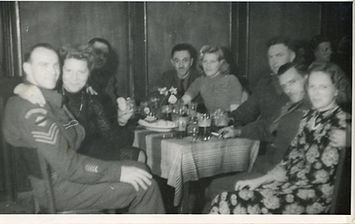
These nine postcards have photos printed on them depicting Canadian soldiers with their Dutch girlfriends. The photos were taken at “Hotel Jans”, which was located in Hilversum, Netherlands, around June 28, 1945 (as can be read on the back of one photo). However, it was after the Canadian army had liberated the city, since the atmosphere is very calm and lively, with glasses of beer and cigarettes on the tables. From the patches on their uniforms we can understand what role they had in the army.


Photograph of Historic “Hotel Jans”

Hotel Jans. www.gooischpoparchief.nl
Bruce Wellington Huton's WWII Medals


Pictured here are the 5 medals Huton earned throughout the Second World War. From the left to the right is the 1939-1945 Defence Star, The Italy Star, 1939-1945 Defence Medal, 1939-1945 Canadian Volunteer Service Medal, 1939-1945 War Medal.
1939-1945 Defence Star
Soldiers earned this medal by either completing six months of service with the active operations for Navy and Army or serving for 2 months with the active air crew.
The Italy Star
This medal was given to soldiers who had completed operational service in Sicily, Italy from June 11th,1943 to May 8th, 1945.
1939-1945 Defence Medal
The 1939-1945 Defence medal was given out for multiple different reasons, most commonly given to Canadian soldiers after 6 months of service in Britain between September 3rd, 1939, to May 8th 1945. However, this medal was also awarded to men who had served in places under or threatened by air attack for three or more years, completed a year of service overseas or not in their country, served in an area with bomb attacks for six months, served in Hong Kong or Newfoundland for six months, served in mine and bomb disposal for three months and lastly Canadians who served in Palestine, India or Africa.
1939-1945 Canadian Volunteer Service Medal
The CVSM was awarded to anyone who was in the Naval, Military or Air forces of Canada who volunteered their service and completed at least 18 months service. In 2003 this medal was also given to constables of the RCM who volunteered in the Second World War.
1939-1945 War Medal
Awarded to soldiers who completed 28 days of service with the Armed Forces, Merchant Marines, or Merchant Navy in 1939-1945.
Both of the stars are brass, and the circular medals are silver. The two stars are made up of copper and zinc while the circle medals are made up of 80% pure silver. They are all polished and have engravings on the front and back. Condition of the medals is good.


Front
King George VI Coronation Medal
King George VI Coronation Medal
This King George VI Coronation medal was created to commemorate King George VI and Queen Elizabeth’s coronation that took place May 12, 1937. The metal is most likely made from nickel or silver. These medals were given out to over 10,000 Canadians as personal souvenirs, including Sgt. Bruce Wellington Huton. The medal features the British Empire and Commonwealth countries such as Canada, Britain, India, Australia, New Zealand, and South Africa. This medal was most likely stamped at the Royal Mint. King George VI And Queen Elizabeth were featured on the medal.

Back
Italian Bracelet and Necklace for Eva Miller
This bracelet and necklace set was bought by Bruce Wellington Huton for his mother Eva Miller.
He bought it during his time in Italy while he was off on leave during World War II. The technique that is used on the bracelet and necklace is Filigrana made from an unknown metal. All the images are monuments in Europe, including Palazzo Vecchio and Cathedral Santa Maria del Flore in Florence, Gondala and Piazza San Marco in Venice, Vulcano Vesuvio in Naples, Vatican City San Pietro cupola, Castel Sant’ Angelo in Rome and Battistero, Tower of Pisa.


The following interview was conducted by Country Roots with Bruce Huton later in his life, as he reflects on moments from his service during the Second World War.

